
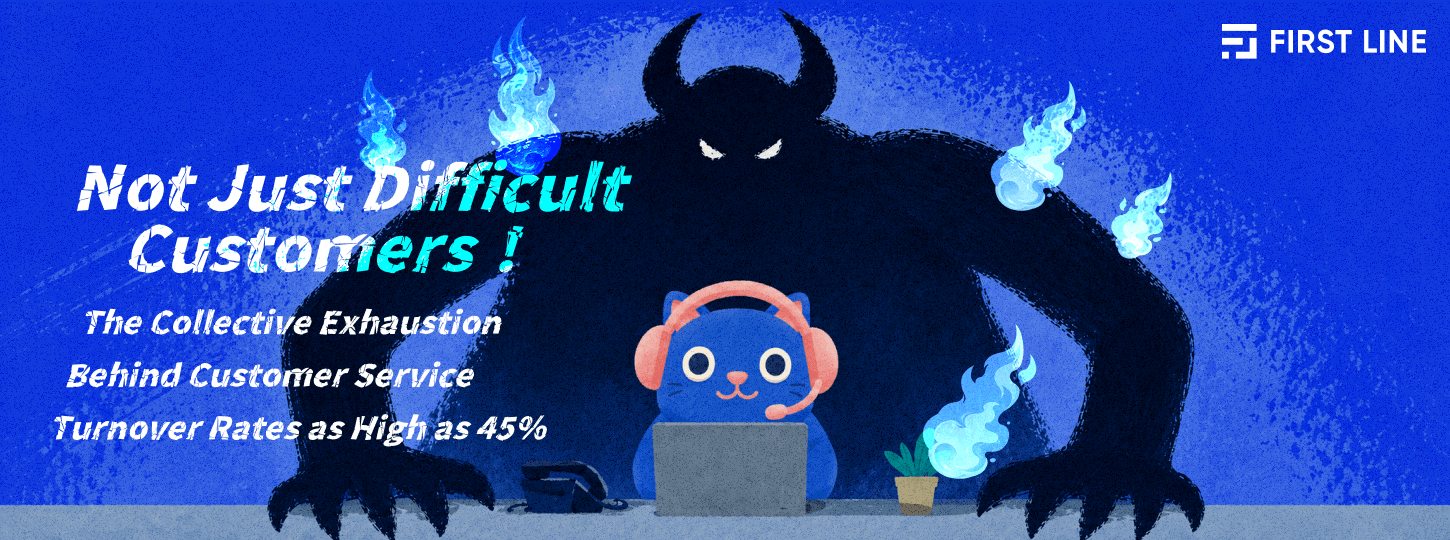
In the eyes of many, customer service is a stable job with a relatively low barrier to entry. Unlike salespeople, who face relentless pressure to meet targets, or engineers, who often work around the clock to meet project deadlines, customer service representatives simply sit in an office, answer calls, respond to messages, and talk to customers—all while earning a paycheck.
What most people do not realize, however, is that this seemingly simple routine is actually an invisible mental marathon.
According to a Servion report on customer service burnout, as many as 87% of customer service professionals worldwide operate under sustained high levels of stress, while 74% face an ongoing risk of burnout. This intense pressure has directly contributed to alarming turnover rates: customer contact centers around the world report annual attrition rates of 30% to 45%, with most employees leaving the profession after only 13 to 15 months.
These figures suggest that customer service is far more than just a busy job. What truly wears people down is the invisible burden of emotional labor.
Psychological research shows that when customer service representatives encounter unreasonable demands or verbal abuse from customers, they are often required to engage in what is known as surface acting in order to maintain the company’s professional image. In other words, even when they feel hurt, frustrated, or angry inside, they must continue to present themselves with courtesy, patience, and a smile.
- Research Evidence: A study on online customer service and emotional labor published on ScienceDirect confirms that this form of emotional dissonance—where outward expressions conflict with genuine feelings—significantly reduces job satisfaction and is one of the most powerful drivers of burnout and psychological exhaustion.
- A Realistic Scenario: Imagine clocking in for work in the morning and answering your first call of the day, only to be greeted by an irate customer launching into an unreasonable verbal attack. You have done nothing wrong, yet for the next 15 minutes, you must apologize repeatedly in the calmest and most empathetic tone possible. The moment the call ends, before you even have time to catch your breath, the next incoming call alert sounds—and within a second, you are expected to switch back to a cheerful and energetic voice.
This relentless cycle of suppressing one’s authentic emotions day after day is perhaps the heaviest and most overlooked occupational hazard faced by customer service professionals.
Customer Service Professionals Spend Every Day Doing Something Extremely Draining: Managing Their Emotions
Every day, customer service professionals engage in an invisible mental drain: constantly regulating their emotions throughout the workday.
Anyone who has worked in customer service will immediately recognize this scenario:
Sitting in front of a computer screen, you may be trembling with frustration after dealing with an unreasonable customer, or completely exhausted after handling an overwhelming wave of complaints. Yet the moment you answer the next call or type the next response, you are expected to switch instantly back to your most patient, professional, and reassuring tone. To make matters worse, many organizations even include “maintaining a consistently positive, enthusiastic attitude” as part of their performance evaluations.
In psychology, this requirement to constantly “wear a mask” at work is defined as emotional labor.
The psychological toll of this daily performance is far more severe than most people realize.
A meta-analysis published in an international academic journal examining the impact of emotional labor on mental health found that employees who frequently engage in surface acting—suppressing their true feelings while projecting a positive outward demeanor—often experience significant psychological strain due to persistent cognitive conflict between their internal emotions and external behavior.
The study revealed several notable findings:
- Psychological Exhaustion: Surface acting was strongly associated with depressive symptoms, with a correlation coefficient of r = 0.333, representing a statistically significant moderate positive relationship.
- Mental and Physical Distress: This constant emotional masking was also significantly associated with anxiety, chronic insomnia, and other sleep-related disorders.
In contrast, deep acting—the practice of genuinely attempting to understand a customer’s perspective and cultivating authentic empathy—was found to have substantially lower negative effects on psychological well-being.
Occasional social interactions that require a forced smile may be manageable. However, when employees spend eight hours a day, five days a week locked behind an emotional mask, the brain’s coping mechanisms can eventually become overwhelmed. This prolonged suppression of one’s authentic emotions creates a state known as emotional dissonance, which is widely recognized as one of the primary factors driving customer service professionals toward burnout, emotional exhaustion, and eventual psychological collapse.
Customers’ Negative Emotions Often Become a Psychological Burden for Customer Service Representatives
Many people assume that once a call ends, the problem ends with it. In reality, however, the negative emotions directed at customer service representatives often linger long after work, becoming a psychological burden that is difficult to shake off.
For customer service professionals, logging into their systems each day is often like opening the floodgates to a constant stream of negativity. Unreasonable complaints, emotionally charged outbursts, and even verbal attacks from customers who blame frontline representatives for broader organizational failures accumulate through call after call and message after message.
The cost of being exposed to this relentless barrage of negative emotions is far greater than most people realize.
After-Work Emotional Rumination: The Brain Never Really Clocks Out
A recent study by a research team at the University of Mississippi found that when customer service representatives are exposed to both emotional labor and unfair treatment from customers, their cognitive resources are depleted at an alarming rate.
The study reveals a harsh reality: the damage caused by conflict does not disappear when the call ends.
- Psychological Harm: When facing verbal bullying from customers, the brain activates defensive mechanisms and consumes significant energy suppressing anger.
- A Thief of Sleep: The study found that many customer service representatives continue to involuntarily replay and argue against daytime conflicts in their minds after work—a process known in psychology as emotional rumination. This directly undermines sleep quality that night, leaving them even more exhausted the next day and trapping them in a vicious cycle.
How Companies Overseas Are Responding: Stop Making Employees Fight Difficult Customers Alone
As emotional exhaustion becomes a collective occupational hazard, leading companies overseas have begun changing their approach. Instead of simply demanding that customer service representatives “swallow it,” they are building real psychological support systems:
- Proactive Manager Check-ins: Managers no longer focus only on KPIs, but regularly conduct one-on-one conversations to understand employees’ mental state.
- One-on-One Counseling: Companies provide confidential access to professional psychological counseling, giving employees a safe channel to process the stress and frustration they experience during the day.
- Mental Health Resources and EAPs: Organizations offer practical tools such as meditation resources and online stress-management courses to help employees mentally reset after work.
Keeping customers’ negative emotions from spilling beyond the workplace is not only about protecting frontline employees. It is also critical to maintaining stable business operations.
Has Technology Really Made Customer Service Work Easier?
To reduce labor costs, many companies have invested heavily in AI, chatbots, and cloud-based systems. This has led many people to assume that, with technology becoming so advanced, customer service work must have become much easier.
The reality is different: technology has not necessarily liberated customer service representatives. In many cases, it has tied them down even more tightly, turning them into “technology workers” precisely controlled by algorithms.
After the introduction of AI, life has not automatically become easier for customer service teams. Behind the scenes, two major forms of modern technology-driven occupational stress are making frontline work even harder:
1. Information Overload and the Hell of Multitasking
Having more systems does not mean having less work. According to the latest industry report from Servion, as many as 72% of customer service representatives worldwide say they are under severe pressure from information overload.
- A Realistic Scenario: Today’s customer service representatives often switch between windows at a frantic pace during a single phone call. While calming the customer, they may also need to move between three or four different systems—CRM software, product databases, logistics tracking tools, and internal forms—while simultaneously typing case notes. This kind of high-speed task switching multiplies the cognitive load on the brain.
2. The Fear of “Big Brother” Monitoring
Another, even more serious source of pressure comes from round-the-clock “Big Brother” monitoring behind the system. Modern contact centers use backend systems to quantify employee behavior to an extreme degree:
- Every Second Is Measured: How fast did you answer the call? Did the call exceed the target duration? How long did the customer wait? How many cases did you close today?
- No Room to Breathe: Every system delay, every transfer, and even every “away” status for a bathroom break is tracked by a backend timer. The entire work rhythm is governed by cold, rigid code.
UK Research: The More Advanced the Technology, the Worse the Anxiety
UK workplace health and psychology research, including studies on call center job stress, has pointed out that the core sources of pressure in modern customer service are high call density, lack of autonomy, and constant performance monitoring.
When the pace of work is fully determined by systems and algorithms, employees lose their sense of control over their work. The brain remains in a prolonged state of threat response. This helps explain why, even as technology continues to advance, rates of anxiety and depression among customer service representatives have not meaningfully declined—and may even be rising.
Technology should be a support tool. But under poorly designed KPI management, it can become a more sophisticated digital factory, accelerating the depletion of customer service representatives’ remaining psychological energy.
KPI Pressure Is Damaging the Customer Experience
When companies treat customer service like an assembly line focused on output, employees are not the only ones harmed. The customers you care about most are affected as well.
In pursuit of efficiency, companies often create all kinds of attractive-looking KPIs. The irony is this: the KPI pressure originally intended to improve efficiency is actively destroying the customer experience.
The Cost Behind the Numbers: Up to 80% of Customer Service Representatives Are Being Pushed to the Breaking Point by KPIs
According to a multinational survey conducted by Gartner and Censuswide, the data reveals a workplace crisis under precision monitoring:
- Mental Health Red Flags: As many as 82% of customer service representatives said their company’s current performance evaluation system has seriously harmed their mental health.
- Two Main Sources of Pressure: As many as 75% identified the relentless pursuit of case closure volume and average handle time (AHT) as their biggest source of stress.
When management constantly monitors backend dashboards and demands that representatives close the most cases in the shortest possible time, the job turns into a draining race against the clock.
The Cost of Chasing Speed Is Making Customers Even Angrier
The most dangerous blind spot in this system is that it distorts the essence of service.
When a customer service representative constantly sees a timer counting down and thinks only about ending the call and closing the case as quickly as possible, they have no spare cognitive bandwidth to listen carefully to what the customer actually needs.
The survey also found that as many as 95% of customer service representatives admitted that this overwhelming pressure from metrics directly damages their performance and productivity. The result is that companies believe they are gaining efficiency, but in reality they fall into a deeper vicious cycle:
- Problems Remain Unresolved: In the rush to close cases, representatives can only provide superficial, scripted responses.
- Customers Call Again: Poor customer experience leads customers to call back angrily about the same issue days later, increasing total contact volume.
- Employee Attrition Accelerates: Employees are chased by numbers and criticized by customers every day, eventually choosing to leave—forcing companies to absorb higher recruitment and training costs.
Beautiful performance reports may look good to management, but what truly matters to customers is not how fast the answer comes. It is whether frontline representatives have enough time, trust, and psychological energy to actually solve the customer’s problem.
Remote Customer Service Creates New Psychological Challenges
In recent years, working from home has become a benefit many people envy, and more customer service centers have followed the trend by adopting remote work models.
On the surface, this looks like a win-win: employees save commuting time, gain more flexibility, and companies reduce office rental costs. But recent research has issued a serious warning: remote customer service is not as ideal as many imagine. Instead, it has created a harder-to-detect “invisible island” crisis.
Once employees leave the office, home does not always become a safe harbor. In many cases, it becomes a new pressure cooker. Three hidden psychological risks are especially significant:
1. No Clear End to the Workday: Blurred Boundaries Between Work and Life
A study on the mental health of remote customer service representatives found that when the living room becomes the office, employees commonly face serious digital fatigue. Without a physical transition between spaces, many people’s brains struggle to switch into off-work mode. As a result, work hours are unconsciously extended, and the body and mind remain in a constant state of readiness.
2. Disconnection and Loneliness: Lack of Immediate Peer Support
The study also emphasized that one of the biggest weaknesses of remote work is social isolation.
- In the Office: After being shouted at by an unreasonable customer, you could hang up, turn to the colleague next to you, roll your eyes, vent briefly, or encourage each other while getting water or coffee. Negative emotions could be released and understood in the moment.
- Working from Home: After being verbally attacked by a customer, you are surrounded only by a silent room. You sit alone in front of the computer, silently swallowing the frustration, anger, and sense of defeat.
3. When Stress Has No Outlet, Invisible Exhaustion Becomes More Dangerous
When text and phone calls become the only communication channels, daily team interactions are reduced to cold task assignments. Without the human warmth of in-person colleagues, customer service representatives are more likely to fall into a sense of helplessness when facing workplace setbacks.
This prolonged lack of emotional release and sense of fighting alone is quietly eroding the mental health of remote customer service representatives. What was supposed to improve well-being through working from home can instead become a catalyst for burnout.
The Greatest Pressure in Customer Service Is Actually Long-Term Accumulated Depletion
Many people attribute customer service burnout to one particularly difficult customer or one especially serious complaint call. But recent research and industry data point to a harsher truth: what truly breaks customer service representatives is not a single catastrophic event, but the small, constant, and unavoidable “chronic psychological toxins” embedded in daily work.
At its core, this job is a long-term test of physical and mental endurance.
The daily life of a customer service representative is built from countless high-pressure moments. Every day, they must carry five major burdens at once:
- The Emotional Mask: Surface acting and forced positivity.
- Emotional Residue: Negative emotional rumination that keeps replaying after work.
- Technology Monitoring: Round-the-clock digital surveillance that measures employees down to the second.
- Metric Pressure: Suffocating KPIs that sacrifice service quality in the pursuit of speed.
- The Digital Island: Remote isolation, where employees must process stress alone in front of a screen.
Taken individually, each pressure point may seem survivable. But when they accumulate on the same person for eight hours a day, five days a week, year after year, they create a compounding effect. Over time, this can develop into irreversible anxiety, severe insomnia, depression, and complete occupational burnout.
When many companies see customer satisfaction decline, their first reaction is usually to spend heavily on upgrading AI, buying more advanced cloud customer service systems, or introducing more digital tools. But leadership often overlooks the most critical component in the system: no matter how quickly AI routes the case, the person who eventually has to calm the angry customer is still a human employee.
If companies genuinely want to improve customer experience (CX), they must stop treating customer service representatives as disposable resources and re-examine the work environment by building four human-centered safeguards:
- Reduce Multitasking Hell: Improve backend interfaces and reduce the cognitive load caused by forcing employees to switch between three or four systems while handling a single case.
- Remove Suffocating KPIs: Provide reasonable call handling time and rest periods. Stop letting backend timers push representatives to rush customers for the sake of speed.
- Build an Emotional Firewall: Provide practical and confidential counseling resources, along with regular one-on-one manager check-ins, so employees have a safe outlet for frustration.
Attractive systems and algorithms can only provide the foundation. The real ceiling of customer experience will always be determined by the psychological energy and well-being of frontline customer service representatives. If companies continue draining employees, the backlash—soaring turnover and collapsing service quality—will ultimately return to the business itself.
- The Impact of Emotional Labor on Mental Health: A Systematic Review and Meta-analysis
- New Research Explores Mental Health Costs of Emotional Labor and Customer Injustice
- Faking It at Work: Emotional Labor and Customer Injustice
- The Quiet Reality of Agent Burnout in 2026
- Call Center Agents Feel the Pressure, and It’s Hurting Customer Experience
- Why Call Centres Remain High Stress Environments in 2026
- Relationship Between Stress Management Practices and Job Performance Among WFH Call Center Employees